
I don’t believe, “AI is taking our jobs”. It is instead, helping us to grow. How? It makes us writers design content that consistently performs than just writing good.
My latest post is about how AI understands content, copy and marketing that humans learn too late, and how high-performing marketers actually use AI, leading to the final truth that “AI will not replace writers, but the guesswork”.
Let’s begin how the thought-process starts.
AI Prioritizes Results Over Writing Style
Humans are expression-oriented, whereas AI is outcome-oriented.
Humans pay more attention on writing style, creativity, and sounding smart and unique, whereas AI lets us focus on clicks, retention, conversions, and ranking stability.
Check out the example between a human copy and an AI-optimized copy for the same thing said in a more effective way.
Human copy: “We craft compelling brand stories that resonate deeply.”
AI-optimized copy: “Turn website visitors into qualified leads with conversion-focused content.”
We humans think in pieces and treat content as an isolated task where, blog ≠ email ≠ landing page.
AI thinks content as a connected ecosystem with maintaining narrative continuity and repurposing automatically. So, you can turn 1 AI-assisted blog into a blog post, an email campaign, 5 LinkedIn posts, landing page section, and FAQ content.
Point to note is, just start designing content systems, instead of working on a single asset.
How AI Aligns Content with User Decision Stages?
Understanding search psychology is important. A writer’s first motive should be to follow SERP behavior and write for the users. Most people forget it and assume Google as their audience first. Keyword stuffing disturbs the entire plan.
AI insights, on the other hand, let you stress on why people clicked, why they bounced, and when they scrolled further.
For example, you cannot go well with “In today’s digital landscape…” this time. Here, you have to match the emotional state and search intent in the first 3 lines. So, the best way to go is, “If your content ranks, but it doesn’t convert, the issue is intent’s mismatch and not the traffic.”
Remember, the best thing is, humans can be biased and emotionally attached, but AI has no ego and no emotional attachment. Thus, AI actually outperforms humans in discipline and not in creativity.
High-Performing Marketers Use AI Strategically
Check out the framework table given below.
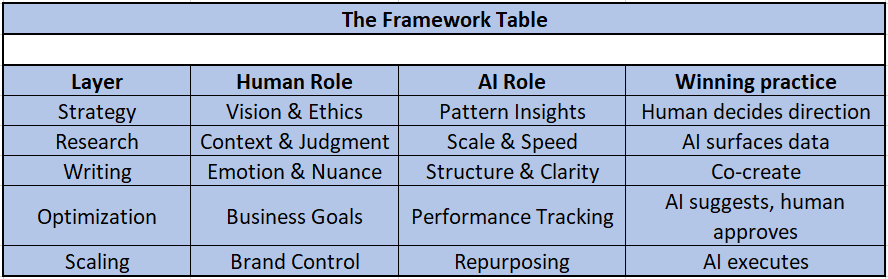
For example, AI helps you in analyzing top 20 SERPs for your SaaS blog workflow with proposing outline and FAQs. You would have to refine angle & POV and sharp emotions & brand. AI will suggest SEO and CTA improvements.
Real Learning Examples
Example 1:
AI adds specificity to your content, reduces abstract language, and signals value upfront.
Human headline: “Why Content Strategy Matters?”
AI-informed headline: “What a High-Performing Content Strategy Looks Like? (With Real Examples)”
Example 2:
CTA psychology lowers friction and it benefits you from shifting focus from actions.
Best step is to write “See How This Works for Your Business” than just finishing out with “Get Started”.
Example 3:
Emotions in brand storytelling works after clarity and not before.
Human approach: Long emotional backstory
AI-assisted approach: Outcome-first → Story → Proof
Example 4:
SEO paragraph optimization using AI compresses value into a single dense paragraph.
AI Understands Better What Works
Imagine you are making a presentation, but on what aspect you would rely most to create it? Most writers will again point towards ‘creativity’. But, the need here is to ask yourself whether it would work well or not.
Humans mostly run towards chasing originality, whereas AI respects patterns. When we move after publishing our draft, AI optimizes endlessly. However, the essence lies not just in how advantageous AI is, but in ‘AI-literate humans’.
Train Yourself, Think Like AI
Try intent rewriting. Start by reading the introduction para you have written and rewrite it by answering the following questions:
- What problems readers are facing?
- What are their decisions?
- What results they are looking for?
Study patterns like AI does. For example, research and analyze top 5 ranking articles from the niche you have chosen and note their headline structure, CTA placement, content length, and section flow. This is the way AI learns.
Remember the following mental model to learn AI, combining 3 important constituents:
- Predictability is trusted not treated as boring
- Structuring means freeing and not restricting
- Data should direct, instead of killing creativity
Final Words
As I said earlier, AI should be used to replace the guesswork and not the writer. AI works to understand how you should use tools to lead strategy, command higher value, and build scalable influence.
 Richa Envisions
Leave a comment